
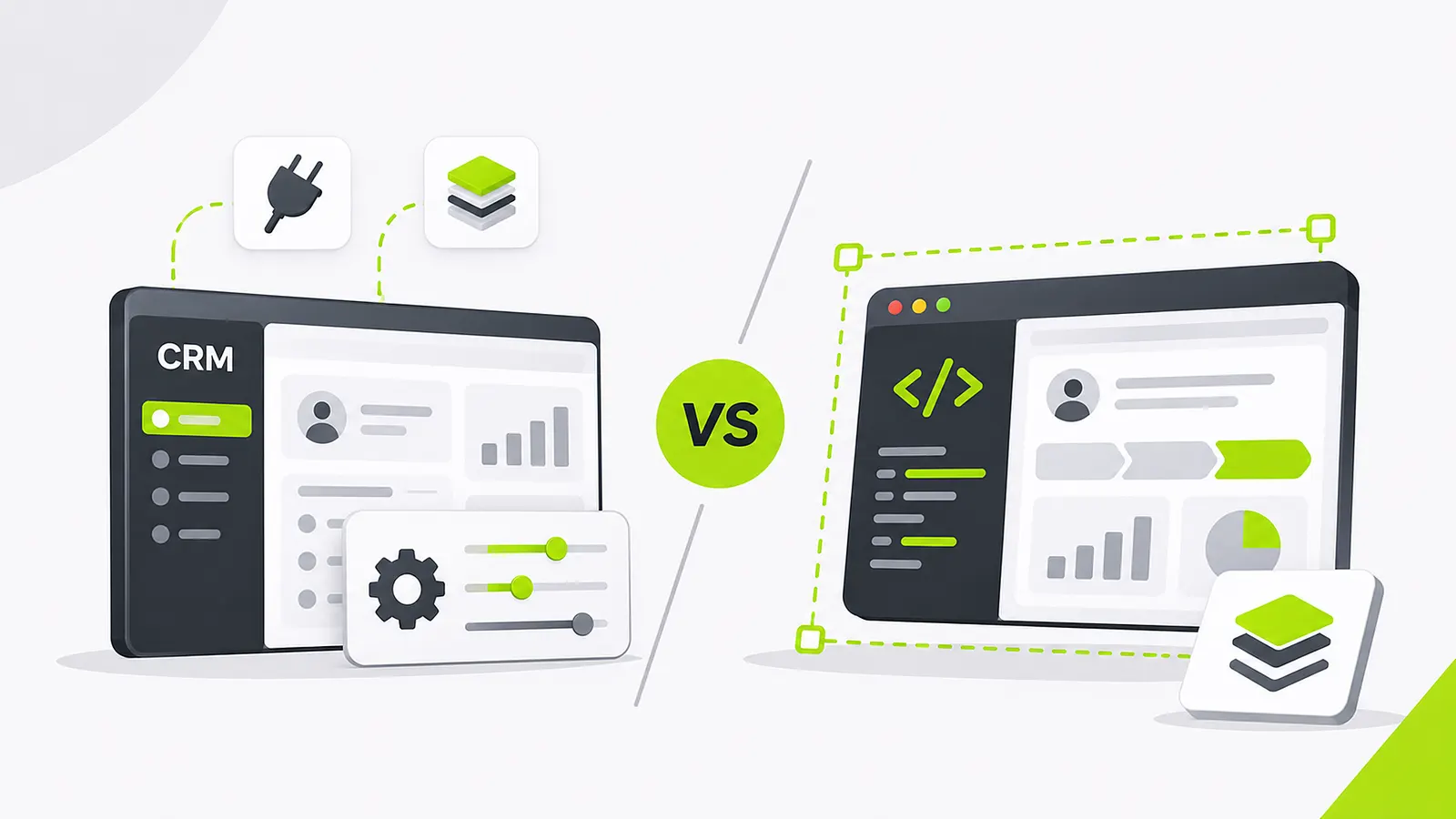
A sales manager wants one more field on the HubSpot lead form. That is customization. A logistics company wants every closed deal to create a route plan, equipment assignment, deposit schedule, and driver workflow. That may be something larger. Knowing the difference protects your budget.
Quick answer
Customize an existing CRM when the platform already handles your core sales process and can support missing needs through configuration or supported integrations. Consider building a new CRM when essential workflows, control requirements, or long-term total costs make the existing foundation a poor fit.
Test the limits of configuration first
HubSpot, Salesforce, Pipedrive, and Zoho all support custom properties, pipelines, automations, roles, reports, and integrations. Before proposing a rebuild, ask whether those features solve the problem. A new CRM must still reproduce imports, duplicates, activity history, search, and permissions.
An integration can also bridge gaps. If HubSpot records the deal and Insiflow or a dispatch tool manages fulfillment, connecting them may beat combining them.
When customization turns into a maze
Warning signs include extensive workarounds, overlapping add-ons, unreliable syncs, inconsistent reporting, and critical processes living outside the CRM. Another sign is a business model the platform's objects or permissions cannot represent cleanly.
Write the root problem and required outcomes. We want full control is too broad. We need branch-specific ownership, multi-step approval, and a direct link to dispatch is measurable.
Building this for your team? Send Insiyon a short request · Decide customize vs build with Insiyon
Compare ownership responsibilities
With customization, the vendor usually maintains the platform while you own configurations and integrations. With a custom CRM, you gain flexibility and also testing, security, hosting, maintenance, and upgrades. A configurable white-label foundation can sit in the middle when branding and workflow changes are the main need.
Model total cost over several years, including migration and retraining.
| Factor | Customize current CRM | Build new / white-label base |
|---|---|---|
| When it fits | Core sales process already works; gaps are local | Objects, permissions, or handoffs cannot be represented cleanly |
| Speed | Usually faster via fields, automations, integrations | Slower until a working foundation exists |
| Risk of maze | High if you stack fragile workarounds and add-ons | High if you rebuild commodity CRM basics poorly |
| Who maintains the core | CRM vendor | You or your product partner |
| Middle path | Integrations to operations tools | Insicore-style foundation + targeted custom modules |
Make the decision with a pilot
Pick the most painful end-to-end process. Try it with current customization, or prototype it on a candidate platform. Evaluate user time, error rates, cost, and supportability. That evidence beats a vendor demo or an architectural preference.
- One painful process
- Pilot it
- Workaround stack
- Reassess fit
- Full CRM rewrite
- Rare first move
Evidence beats preference and vendor demos.
Overlapping add-ons and dual entry are warning signs.
Configure or integrate before replacing the system of record.
Bars show relative emphasis, not measured scores.
How teams choose configure vs rebuild
A Minneapolis logistics firm needed every closed deal to create route plans and deposits. Custom HubSpot fields turned into a maze, so they piloted one process three ways: configure, integrate to dispatch, and an Insicore prototype. Integration plus a bounded custom module won.
An Orlando home-services franchise did not have unique CRM objects. It had inconsistent pipelines across locations. Standardization and training beat a new CRM build.
Failure cases and decision rules
Failure cases: rebuilding contacts/email poorly, stacking fragile add-ons forever, and migrating before piloting one painful process.
Rules: configure first; integrate second; white-label foundation when branding/ownership matter; full build last and only with evidence from a pilot.
How Insiyon chooses customize, integrate, or build
We start with one painful process and three options: configure the current CRM, integrate it to Insiflow or Insicore, or build a bounded custom module. Only when ownership rules and operational handoffs cannot fit do we recommend a full new CRM.
That keeps the recommendation small enough to test and large enough to remove the workaround that is actually hurting the business.
Next step with Insiyon
Share your biggest CRM workaround with Insiyon. We can help decide whether customization, integration, a white-label platform, or a new build makes sense.