
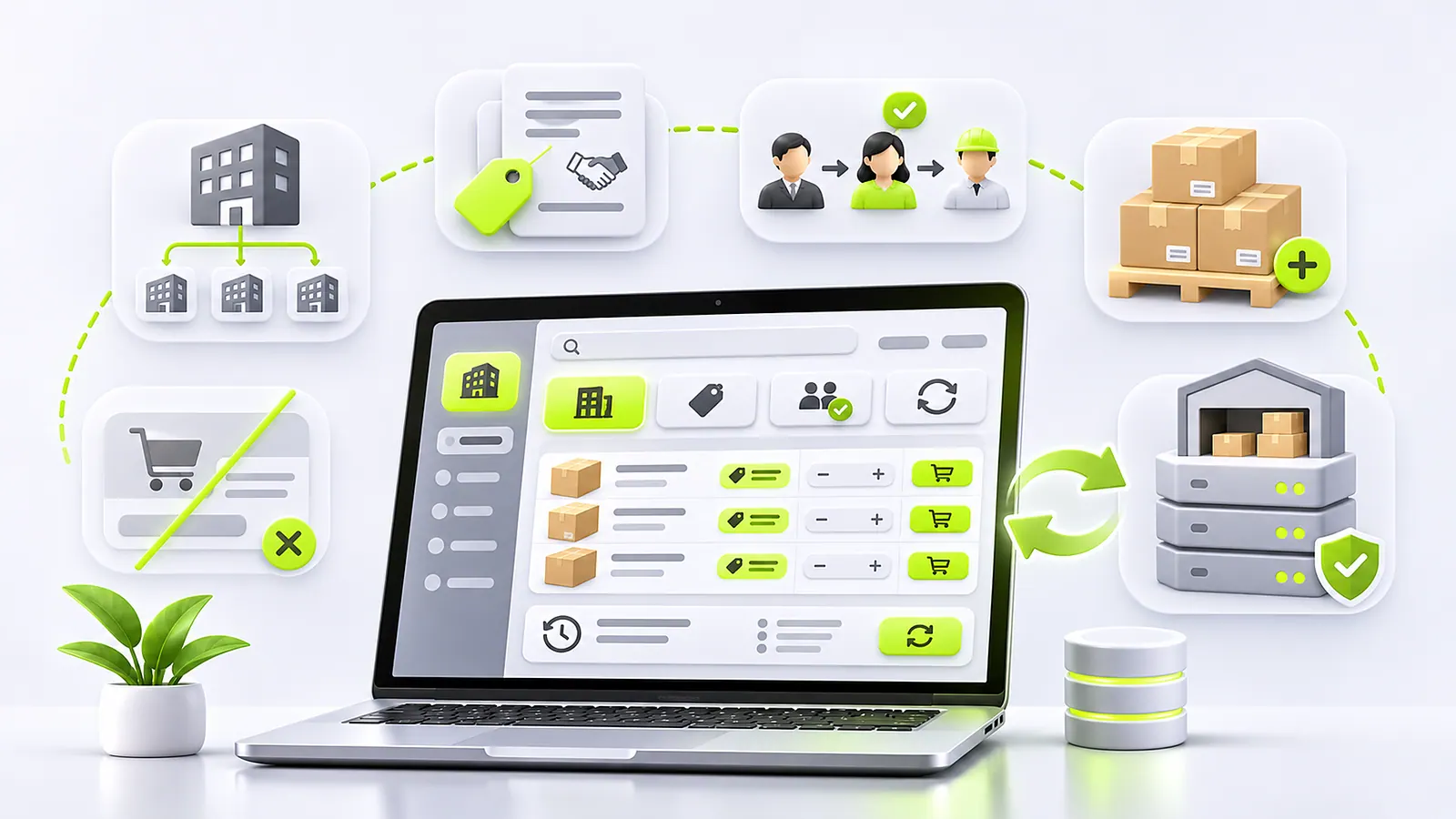
A business buyer does not always want the same experience as an online retail shopper. They may have a negotiated price list, account credit, recurring orders, multiple approvers, and a purchasing team. That is why B2B ordering software should not be designed as a consumer storefront with a company-name field added.
Quick answer
B2B ordering software typically needs account-based catalogs, negotiated pricing, bulk quantities, purchasing permissions, order approvals, inventory visibility, credit or invoice terms, repeat ordering, and ERP integration. Cost depends on business rules and system connections more than visual design alone.
Design for the real buyer
A procurement manager may create an order for approval rather than purchase immediately. One account might have multiple ship-to locations and people with different permissions. Customers may order by SKU, upload a purchase order, or repeat a standard basket each month.
Map the buyer, approver, account manager, warehouse, and finance workflows. A smooth interface cannot compensate for a product that ignores purchase rules.
Treat pricing as business logic
B2B prices may vary by contract, customer tier, quantity, location, tax treatment, and payment terms. Decide which system owns the authoritative price. If the ERP is the source of truth, the ordering platform should request or synchronize prices reliably and handle stale data.
Inventory brings similar challenges. Available may mean stock in a specific warehouse, incoming stock, or reserved stock for priority accounts. Prevent overselling and define what happens with partial fulfillment and backorders.
| Driver | Why it costs | MVP guidance |
|---|---|---|
| Account pricing | Contracts, tiers, quantity breaks | One price source of truth |
| Approvals | Multi-person purchase rules | One approval path first |
| Inventory meaning | Warehouse, reserved, incoming stock | Define available explicitly |
| ERP sync | Duplicates and stale prices hurt ops | Idempotent create + exception queue |
Building this for your team? Send Insiyon a short request · Explore Insistock B2B ordering
Prioritize integrations and resilience
Common integrations include ERP, inventory management, accounting, shipping, payment services, and CRM. Use stable identifiers, idempotent order creation, reconciliation reports, and exception queues. A duplicate order from a retry can create real warehouse work and cost.
An MVP might start with a searchable catalog, account-specific prices, cart, approval or order submission, status tracking, and an admin panel. More complex procurement integrations and contract rules can come later if not essential.
Illustrative engineering risk share
30%
largest share
- Pricing + inventory rules30%
- ERP / sync resilience30%
- Approvals + account roles20%
- Catalog UX / admin20%
Illustrative weights — not audited market research.
Build or configure?
A configurable B2B platform can reduce initial delivery time. A custom build may be justified by unusually complex pricing, procurement, or operational processes. Include hosting, maintenance, data migration, and integration support when comparing costs.
- Standard account orders
- Configure first
- Exotic procurement
- Custom leans in
- Success test
- No retyping
Insistock-style foundations often cover the core loop.
Unusual contracts and multi-ERP edges.
Buyer intent becomes a clean warehouse/finance record.
Bars show relative emphasis, not measured scores.
| Scope | Setup / build (USD) | Year-1 extras |
|---|---|---|
| Configure Insistock-style foundation | About $20k–$60k setup + platform | ERP sync, training, support hours |
| Custom MVP (accounts, prices, approvals) | About $80k–$200k | Hosting, maintenance, first ERP connector |
| Complex multi-ERP / contracts | About $200k–$450k+ | Resilience, exception queues, finance ops |
Year-1 TCO and exclusions
Model year-1 as setup + platform + ERP connector maintenance + buyer training. Exclude open-ended catalog redesigns and every procurement edge case until a pilot proves the core loop.
| Include | Exclude until scoped |
|---|---|
| Account pricing source of truth | Every contract edge case day one |
| One approval path | Full procurement suite for all orgs |
| Idempotent ERP order create | Replacing the ERP itself |
| Buyer + warehouse training hours | National GTM experiments |
How distributors scope ordering software
A Milwaukee distributor watched buyers email PDFs full of negotiated prices. An Insistock-style catalog with account pricing and one approval path cut the retyping. The pilot metric was simple: what share of orders reached the warehouse without manual edits.
A Jacksonville wholesale group already knew the ERP owned price truth. They scoped idempotent order create and an exception queue before anyone polished the storefront.
Decision rules and failure cases
Failure cases: treating B2B like Shopify with a company field, dual price sources, and no approval path.
Rules: name the price source of truth; one approval path in MVP; idempotent ERP sync; configure first when account orders are standard.
How Insiyon scopes B2B ordering
Insiyon offers Insistock as an inventory and B2B ordering foundation. Before estimating, we invite an actual buyer to complete a repeat order, then ask account managers and warehouse staff to review the resulting record.
If buyers must call staff to confirm negotiated prices, or warehouse staff retype every order, the storefront is not yet doing its job. The first release should produce a reliable order record from buyer intent through fulfillment and invoicing.
Next step with Insiyon
Tell Insiyon how your buyers place orders today and which ERP or inventory tools you use. We can scope a focused B2B ordering experience.