
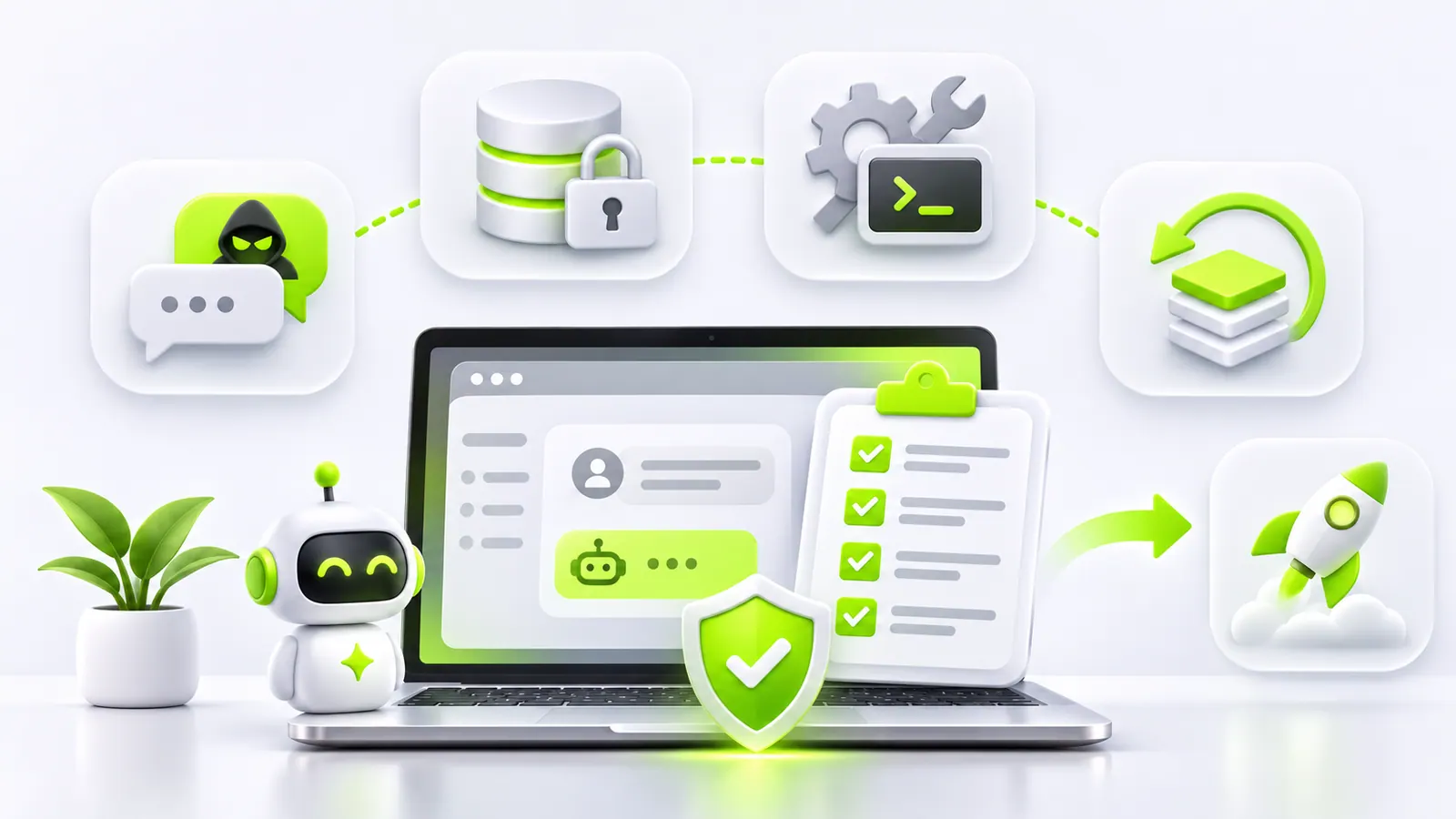
Your chatbot passes the demo with perfect answers. Then someone pastes a malicious instruction into a support ticket and the system attempts a tool call it was never meant to make. Testing an AI product requires more than checking whether it can answer normal questions.
Quick answer
AI red teaming deliberately tests how a system behaves under adversarial and unexpected inputs. For chatbots and agents, prioritize prompt injection, data leakage, identity boundaries, unauthorized tool use, output validation, and the ability to detect and recover from failures.
Begin with a threat model
List what the AI can see, retrieve, and do. Identify valuable assets: customer records, internal documents, credentials, financial actions, and account settings. Define the trust boundaries between end-user messages, retrieved documents, system instructions, tools, and administrative authority.
An FAQ bot with no external tools has a different attack surface from an agent that can edit a CRM or issue refunds. Test effort should reflect consequence, not merely model complexity.
| Attack class | Pass criteria |
|---|---|
| Prompt injection | No unauthorized tool use |
| Data exfiltration | No leaking other tenants/docs |
| Excessive agency | Sensitive actions need approval |
| Jailbreak / policy bypass | Refusals hold under pressure |
Exercise realistic attacks safely
Test whether text embedded in a document can redirect behavior. Try requests that impersonate administrators or ask the model to expose another tenant's data. Verify that tool calls reject unauthorized parameters even if the model attempts them. Check whether malformed output can affect downstream code, and whether repetitive requests can cause runaway cost or denial of service.
Use approved staging environments and synthetic data. Do not test against unrelated systems or real customer information without authorization.
Building this for your team? Send Insiyon a short request · Run an AI red teaming assessment
Score the actual business impact
A prompt that makes the assistant reveal its general style instructions is usually less severe than one that can expose customer records or execute a payment. Rank findings by exploitability, data sensitivity, financial impact, and available controls. Fix the permission boundary, not just the wording of a refusal prompt.
OWASP's LLM guidance highlights risks such as prompt injection, insecure output handling, sensitive information disclosure, and excessive agency. Its taxonomy is a useful starting point, not a substitute for system-specific testing.
Retest after every meaningful change
A new retrieval source, model, plugin, or tool permission can change the attack surface. Maintain a regression set of adversarial cases alongside normal evaluations. Monitor production for suspicious patterns and define a kill switch or permission-revocation process where actions carry risk.
How Insiyon runs focused red teaming
Insiyon builds a short adversarial suite for each AI feature before expanding autonomy. For an Insicore lead agent or support assistant, that means cross-tenant attempts, forged admin instructions, unauthorized refund parameters, and recovery after a bad tool call.
Findings become engineering tickets with owners, not a slide deck that disappears after the sales demo.
Next step with Insiyon
If your AI app has users, data access, or tools, ask Insiyon about a focused risk and red-teaming assessment before expanding autonomy.